
CALIME / Gut, digestion and diet
Probiotic, prebiotic and postbiotic - what is the difference?
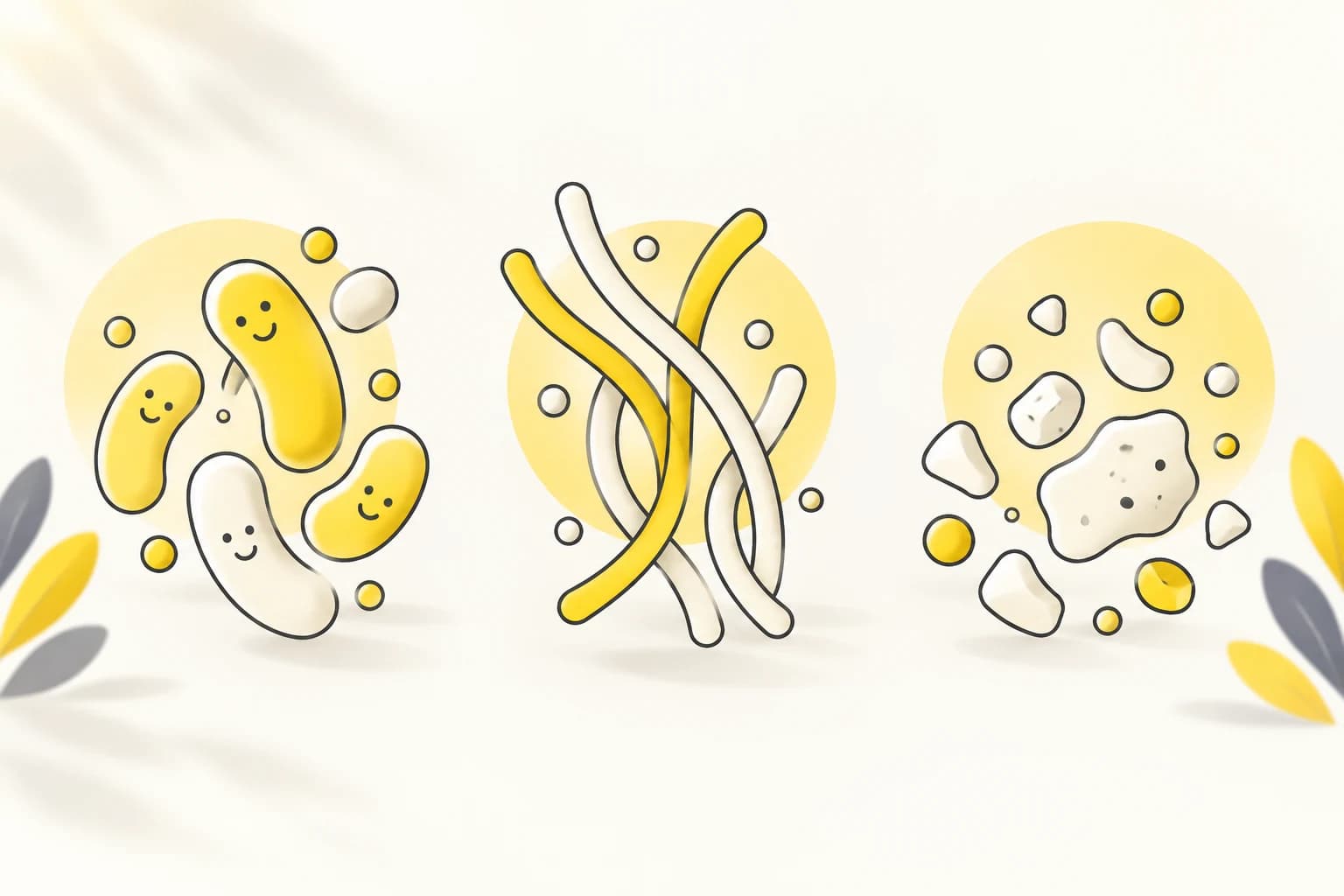
Probiotic, prebiotic and postbiotic refer to different things: living microorganisms, substances they use, and preparations containing inactive microorganisms or their components.
contact@calime.app · +48 533 223 143
Let us first clarify the basic terms
The gut microbiota is a community of microorganisms living in the digestive tract. Microbiome is sometimes used more broadly to include the genes of these organisms and their environment. It is a dynamic system influenced by factors including diet, age and medicines. There is no single list of bacteria that describes the ideal gut for every person.
Watch the Polish version on YouTube
You can picture it by thinking of a meal. It provides various substances, some of which microorganisms may use. Processes involving these organisms lead to the formation of other compounds. However, a substance used by microorganisms, a living cell and a component of that cell are three different things.
Probiotic: living microorganisms with a specific effect
In the scientific definition, probiotics are living microorganisms that, when administered in adequate amounts, provide a documented benefit to the host, meaning the person who takes them. The fact that a capsule contains bacteria is not enough to attribute to it the results of all research on probiotics. Factors that matter include the exact strain, the amount used, the group of people studied and the outcome assessed.
A strain is a more precisely identified variant of a microorganism within a species. By way of comparison, the species name is like a family name, while the strain designation identifies a specific individual. Lactobacillus acidophilus is a species name; an additional code may identify a specific strain. Scientific names change over time. For example, Bacillus coagulans may now be called Weizmannia coagulans, although a change of name does not necessarily mean that the microorganism itself has changed.
Prebiotic and postbiotic are not synonyms for probiotic
A prebiotic is a substance that the host's microorganisms selectively use, and whose consumption is associated with a demonstrated health benefit. Inulin and some fructooligosaccharides are often discussed as prebiotics. Fructooligosaccharides, or FOS for short, are a type of carbohydrate. Not all fibre automatically meets the definition of a prebiotic. Nor can we assume that findings on one amount of inulin apply to any amount.
According to the ISAPP consensus, an agreed definition prepared by an international association of experts, a postbiotic is a preparation of inactive microorganisms or their components for which a benefit has been demonstrated. A purified metabolite, meaning a compound produced through metabolic processes, is not sufficient for this classification. A product does not become a postbiotic simply because some of its cultures lose viability during storage.
How should you read research findings?
A scientific review may combine studies of different strains and uses. The average result of such a review does not prove that every formulation works in the same way. Conclusions can be applied to a specific product only when it matches the preparation studied. Furthermore, an improvement in one measured indicator does not necessarily mean an improvement in every aspect of health.
An agreed definition helps clarify terminology, but on its own it does not authorise making a health claim about a supplement in advertising. Below, we describe the compositions and formats of selected CaliVita® products, not promises to treat intestinal diseases.
Three different CaliVita® options
The ingredients of AC-Zymes Plus list six bacterial species and FOS. Pure Inulin is a powder containing inulin from chicory root. PureBiom+ gives the designation of a specific strain and also contains fenugreek extract. The table below sets out these differences. Here, a serving means a specified amount of the product described on the label; it is not the same as an individual recommendation for use.
| Product | Amount of product described on the label | What stands out in the composition |
|---|---|---|
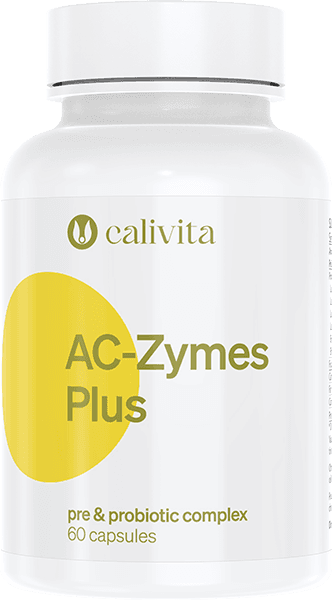
| AC-Zymes Plus | 1 capsule | Six listed bacterial species and 200 mg FOS from chicory root. |
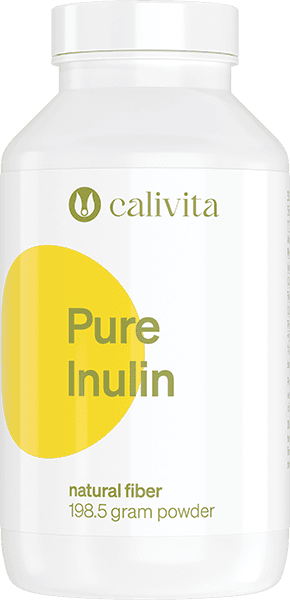
| Pure Inulin | 1 serving - 1 teaspoon (5,8 g) | Powdered inulin from chicory root: 5,8 g. |
| PureBiom+ | 1 capsule | Weizmannia coagulans strain MTCC 5856 and fenugreek seed extract. |
The figures refer to different amounts of product. For AC-Zymes Plus, the label gives the amounts per capsule. Each of the six listed species is declared at 1 billion, so adding these amounts gives 6 billion in one capsule: 1 billion × 6 = 6 billion. The abbreviation “mld” means one billion. This is the sum of the declared amounts, not information about effectiveness or a recommendation to take the product.
Pure Inulin is described as 1 serving, that is, 1 teaspoon weighing 5,8 g; this amount provides 5,8 g powdered inulin. A serving does not automatically mean one teaspoon for every user.
The PureBiom+ label gives the amounts per capsule.
A milligram, written as mg, is a unit of mass; 1000 mg is 1 g, or one gram. In PureBiom+, the MTCC designation 5856 identifies the strain, not a promise of a specific effect. The abbreviation DER in the notation DER 12:1 means the ratio of the plant material used to the extract obtained. Standardisation to 45% galactomannan indicates a specific component of the extract. These are details about the composition, not in themselves therapeutic indications.
AC-Zymes Plus may interest someone comparing a capsule with several bacterial species and added FOS. Pure Inulin offers a closer look at inulin powder on its own, without added bacterial cultures. PureBiom+ stands out for its identified strain in a plant-based capsule and its fenugreek extract. These are different formulations, not a ranking of products suitable for everyone.
People with seriously weakened immunity, a severe illness or specialist treatment should discuss preparations containing live cultures with a doctor. If symptoms persist, it is worth looking for their cause rather than attributing them to the microbiota on your own.
CaliVita® product comparison
The comparison describes the products’ composition and form. It does not determine individual requirements or provide supplementation recommendations.
| Product | Composition and serving | What makes it distinctive | When this option may be suitable |
|---|---|---|---|
| AC-Zymes PLUS | 60 capsules 1 capsule contains: Fructooligosaccharides (FOS) from chicory root: 200 mg Bacterial cultures (Lactobacillus acidophilus): 1 billion Bacterial cultures (Lactobacillus bulgaricus): 1 billion Bacterial cultures (Lactobacillus plantarum): 1 billion Bacterial cultures (Lactobacillus rhamnosus): 1 billion Bacterial cultures (Bifidobacterium breve): 1 billion Bacterial cultures (Bifidobacterium longum): 1 billion | The capsule contains six listed bacterial species and FOS from chicory. The sum of the declared amounts of bacteria is 6 billion in one capsule. | May suit someone comparing a multi-species capsule formula with a small amount of added FOS. |
| Pure Inulin | 1 serving - 1 teaspoon (5,8 g) Contains: Powdered inulin from chicory root: 5,8 g | Pure Inulin allows a comparison with a composition limited to inulin and a powder format. The label describes the composition and conditions of use. | A clear point of reference when the subject of analysis is inulin on its own, without added bacterial cultures. |
| PureBiom+ | 30 plant-based capsules 1 capsule contains: Weizmannia coagulans MTCC 5856 (LactoSpore®): 2 billion Common fenugreek seed extract (DER 12:1): 106 mg Standardised to 45% galactomannan: 47,7 mg | The plant-based capsule contains the identified strain Weizmannia coagulans MTCC 5856 and fenugreek extract standardised for galactomannan. | May interest someone examining the MTCC strain designation 5856 and a plant-based capsule with fenugreek extract. The strain designation alone does not establish a therapeutic indication. |
Sources and further reading
- ISAPP 2017 - definition and scope of prebiotics
- ISAPP 2021 - definition and scope of postbiotics
- NIH ODS - probiotics, the importance of strains and safety
- List of authorised health claims - Regulation (EU) No 432/2012
- CaliVita® - AC-Zymes Plus, product information and label (PL market)
- CaliVita® - Pure Inulin, product information and label (PL market)
- CaliVita® - PureBiom+, product information and label (PL market)
Products related to this article
See retail prices and potential membership savings, then check the distributor basket before you decide.
 Pure InulinRetail price€38.44Join CaliVita Cluband Save 9.54 EURAfter meeting CaliVita membership terms. Confirm the final price with the distributor.Details and basket →
 AC-Zymes PLUSRetail price€47.75Join CaliVita Cluband Save 11.85 EURAfter meeting CaliVita membership terms. Confirm the final price with the distributor.Details and basket →
 ProbioZymesRetail price€36.58Join CaliVita Cluband Save 9.08 EURAfter meeting CaliVita membership terms. Confirm the final price with the distributor.Details and basket →
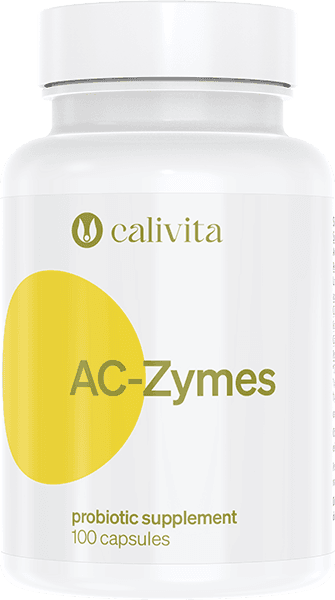 AC-ZymesRetail price€32.58Join CaliVita Cluband Save 8.08 EURAfter meeting CaliVita membership terms. Confirm the final price with the distributor.Details and basket →
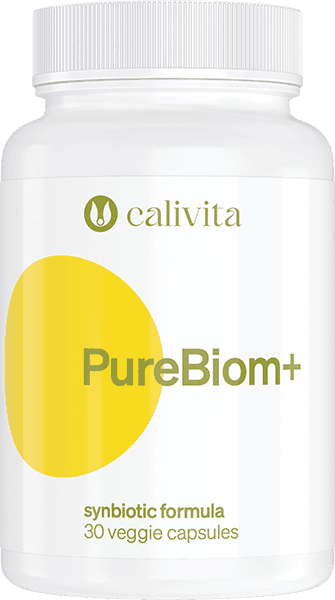 PureBiom+Retail price€33.12Join CaliVita Cluband Save 8.22 EURAfter meeting CaliVita membership terms. Confirm the final price with the distributor.Details and basket →
This text represents only the experiences and/or opinions of the named author(s). Your experiences may differ.
Calime is owned, operated and managed by Michał Zarzycki, an independent CaliVita® Partner, who is solely responsible for each item of content and the entire website. CaliVita® and its national offices are not responsible for this website. Products identified as food supplements have that status; only appropriate health claims apply, not medical claims. Information, statements and opinions about supplements do not replace medical advice. Cosmetics, devices and materials are not food supplements.
This article is for information only. We make every effort to ensure it is as reliable as possible, but it is not medical advice and does not replace a medical consultation. If in doubt, contact an appropriate doctor. A food supplement is not a substitute for a varied diet and a healthy lifestyle.