
CALIME / Informed shopping and labels
How to read a supplement label: serving, ingredients and mandatory information
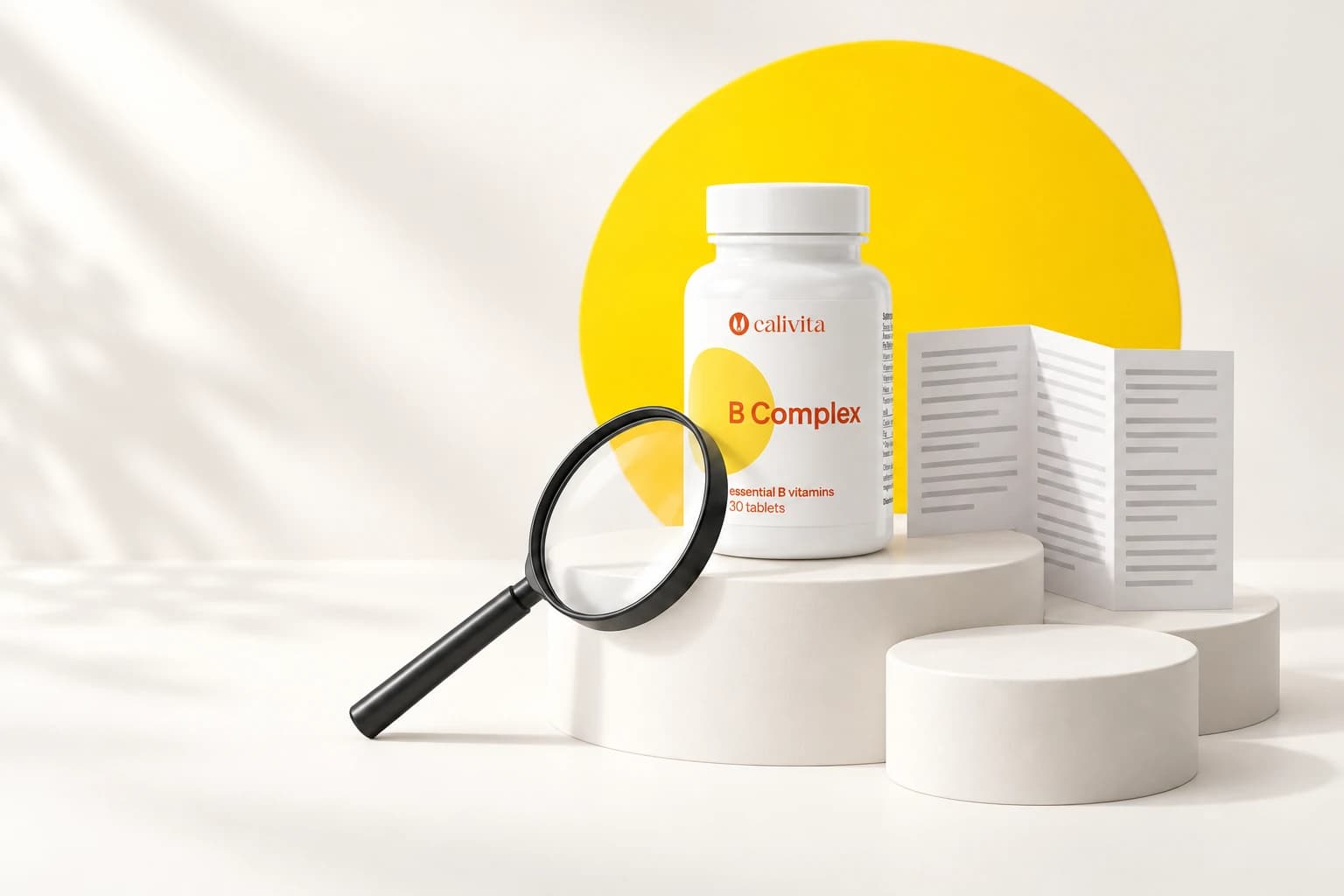
What does a serving mean on a label? Using B Complex, Pure B Complex+ and Omega 3 concentrate as examples, we explain the numbers, units and calculations step by step.
contact@calime.app · +48 533 223 143
Where should you start when looking at a label for the first time?
The product name is on the front of the packaging. There are usually more details on the back: the ingredients list, a table showing their quantities and directions for use. Each of these pieces of information answers a different question. You do not need to understand every name straight away. First, check what the figures in the table refer to.
The most important question is: is the stated quantity of an ingredient in one tablet, several capsules or a specified amount of liquid? Only then can you make a fair comparison between two products. A large number on the front, such as “1000,” or the word “Plus” does not describe the full composition.
Watch the animated explanation
In under three minutes, we walk through the same examples: B12 portions in B Complex and Pure B Complex+, EPA and DHA in Omega 3 concentrate, and the difference between the whole oil and its parts. The video uses Polish-market labels. Calculating contents is not a dosage recommendation.
Watch the Polish version on YouTube
What is a serving, and how is it different from one tablet?
A serving is a specified amount of a product. In the table, the manufacturer may describe one capsule, two tablets or several millilitres of liquid. One tablet is a single unit. A serving made up of two tablets consists of two such units.
Look at the short statement above the table. The wording “2 tablets contain” means that each quantity listed below applies to both tablets together. The wording “1 capsule contains” means that the values apply to one capsule. Read separately the information about how the manufacturer intends the product to be used - you do not need to guess this from the ingredients table.
Example: how much vitamin B12 is in B Complex and Pure B Complex+?
B12 is one of the B vitamins. In the example below, we compare only its quantity, not the full formulation or the effects of the products. The abbreviation “µg” means microgram, a unit of mass used to describe very small quantities. Both labels give the amount of B12 in the same unit, so there is no need to convert it.
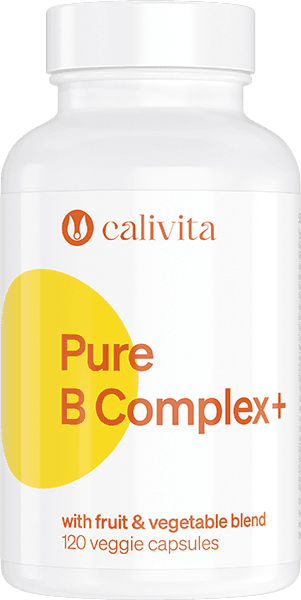
The Polish table for B Complex describes two tablets. Together, they contain 4 µg B12. The Polish table for Pure B Complex+ describes one capsule, which contains 24 µg B12.
| What are we checking? | B Complex | Pure B Complex+ |
|---|---|---|
| Quantity of product described in the table | 2 tablets | 1 capsule |
| B12 in this amount of product | 4 µg | 24 µg |
| B12 in one tablet or capsule | 2 µg | 24 µg |
Where does 2 µg in the last row come from? Two B Complex tablets contain 4 µg in total. We divide this amount by the number of tablets: 4 µg ÷ 2 = 2 µg. For Pure B Complex+, we do not divide anything, because the table refers to one capsule from the start.
- When you compare servings as described by the manufacturers, you compare 4 µg and 24 µg. Remember that the first serving is two tablets, while the second is one capsule.
- When you compare individual units, you compare 2 µg in one B Complex tablet with 24 µg in one Pure B Complex+ capsule.
Both comparisons are valid, but they answer different questions. Pure B Complex+ has a higher stated amount of B12 in the example shown. B Complex has its own blend of B vitamins, with added vitamin C, magnesium, choline and inositol. The amount of B12 alone does not determine which combination of ingredients suits an individual's needs. Nor is it an instruction about how many tablets or capsules to use.
Second example: three Omega 3 concentrate capsules
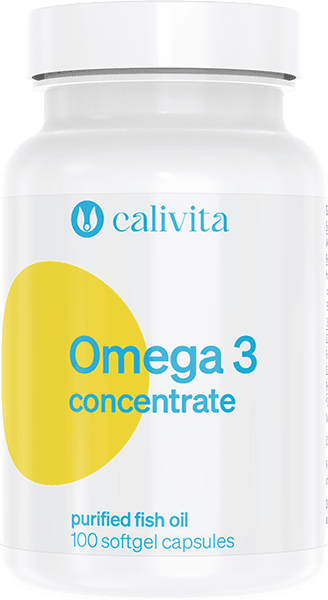
EPA and DHA are two types of omega-3 fatty acids. The label for Omega 3 concentrate lists their amounts separately. The abbreviation “mg” means milligram, a unit of mass. In this example, all quantities are given in milligrams.
The table for this product refers to three capsules together: 540 mg EPA and 360 mg DHA. To find out how much is in one capsule, we divide each quantity by three.
- EPA: 540 mg ÷ 3 = 180 mg in one capsule.
- DHA: 360 mg ÷ 3 = 120 mg in one capsule.
- EPA and DHA together: 180 mg + 120 mg = 300 mg in one capsule.
| What are we calculating? | 1 capsule | 3 capsules |
|---|---|---|
| EPA | 180 mg | 540 mg |
| DHA | 120 mg | 360 mg |
| EPA + DHA together | 300 mg | 900 mg |
The figures 300 mg and 900 mg describe the same product, just different amounts of it. They do not indicate a difference between formulations. This explains the contents; it is not a recommendation to take one or three capsules. Read the directions for use and warnings on the relevant label.
Ingredients list and quantity table - why are both needed?
The ingredients list answers the question “what is the product made from?”. It includes nutrients, raw materials and excipients, which are needed, for example, to make a tablet or capsule. The quantity table answers the question “how much of a particular ingredient is in the described serving?”.
For example, the list may include the name of a magnesium compound, while the table gives the quantity of magnesium itself. These are two different pieces of information. Similarly, the mass of fish oil does not automatically tell you the quantities of EPA and DHA. The oil also contains other components. In a plant extract, meaning raw material obtained from a plant, the mass of the whole extract is not the same as the quantity of each substance it contains.
Pay attention to the words “of which”. They indicate a part of the preceding value. If the manufacturer states the quantity of an extract and then gives the amount of a particular substance “of which”, that substance is already part of the extract. Adding the two figures together would count that part twice. This way of presenting the information helps you understand the product's composition more precisely.
What can you learn from a label, and what needs a separate assessment?
A label lets you compare the ingredients, form and quantities stated by the manufacturer. However, it does not show whether a particular person has a deficiency or how they will respond to a given product. A clinical trial is a study involving people. An ingredients table is not such a study and does not describe its results.
Mandatory information on food supplements is set out in food law. A food supplement is a food intended to supplement the normal diet. The label includes, among other things, the recommended daily portion, a warning not to exceed it, a statement that the product does not replace a varied diet, and a note to store it out of the reach of young children.
The packaging may also show reference values, which are conventional points of reference used to present the quantities of ingredients. They are not a personal supplementation plan. Choosing a product also involves considering diet, other products being used and information relevant to the individual.
How can you compare two products without getting lost in the numbers?
- Check the full name of the variant and the label market, for example Poland. Products with similar names may have different formulations.
- Find the statement above the table: do the quantities refer to one unit, several units, grams or millilitres?
- Choose one ingredient to compare, for example B12. Write down the quantity along with the unit and number of tablets or capsules.
- Decide whether you are comparing the servings on the labels or individual units. If you are comparing individual units, calculate the values as in the example.
- Then look at the rest of the ingredients. B complexes may include B6, B12 and folate, an ingredient belonging to vitamin B9. Also check the product form, allergens and warnings.
- Read the storage conditions and expiry date. Formulations and labelling can change, so the current packaging matters.
You can discuss a comparison of these features with a doctor or dietitian. It helps you see how products CaliVita® differ without choosing solely on the basis of the biggest number on the front of the packaging.
CaliVita® product comparison
The comparison describes the products’ composition and form. It does not determine individual requirements or provide supplementation recommendations.
| Product | Composition and serving | What makes it distinctive | When this option may be suitable |
|---|---|---|---|
| Pure B Complex+ | 1 capsule contains (confirmed on the Polish PDF label). Vitamin B6: 5 mg Folic acid (B9): 400 µg Biotin (B7): 300 µg Vitamin B12: 24 µg | A vegetarian capsule with B vitamins, an organic fruit and vegetable blend and a small amount of Q10. The folate, an ingredient from the vitamin B9 group, is in the form of calcium methylfolate. | An example for people comparing the ingredients in B complexes and the form of a vegetarian capsule. The quantities refer to one capsule, so there is no need to divide them by the number of units. |
| Omega 3 Concentrate | 100 capsules | 3 capsules contain: EPA (eicosapentaenoic acid): 540 mg DHA (docosahexaenoic acid): 360 mg | Fish oil from anchovies and salmon in capsules. EPA and DHA are two separately listed omega-3 fatty acids. The quantities shown are for three capsules together. | An example that helps distinguish the amount of oil from the amounts of its components, and calculate the content per capsule. |
Sources and further reading
- Food information for consumers - Regulation (EU) No 1169/2011
- Directive 2002/46/EC on food supplements
- List of permitted health claims - Regulation (EU) No 432/2012
- CaliVita® - B Complex, product page and label (Polish market)
- CaliVita® - Pure B Complex+, product page and label (Polish market)
- CaliVita® - Omega 3 concentrate, product page and label (Polish market)
- NIH ODS - omega-3, information for readers starting with the basics
Products related to this article
See retail prices and potential membership savings, then check the distributor basket before you decide.
 Omega 3 ConcentrateRetail price€37.90Join CaliVita Cluband Save 9.40 EURAfter meeting CaliVita membership terms. Confirm the final price with the distributor.Details and basket →
 Pure B Complex+Retail price€51.74Join CaliVita Cluband Save 12.84 EURAfter meeting CaliVita membership terms. Confirm the final price with the distributor.Details and basket →
This text represents only the experiences and/or opinions of the named author(s). Your experiences may differ.
Calime is owned, operated and managed by Michał Zarzycki, an independent CaliVita® Partner, who is solely responsible for each item of content and the entire website. CaliVita® and its national offices are not responsible for this website. Products identified as food supplements have that status; only appropriate health claims apply, not medical claims. Information, statements and opinions about supplements do not replace medical advice. Cosmetics, devices and materials are not food supplements.
This article is for information purposes only. We make every effort to ensure it is as reliable as possible, but it is not medical advice and does not replace a medical consultation. If in doubt, contact an appropriate doctor. A food supplement does not replace a varied diet and a healthy lifestyle.